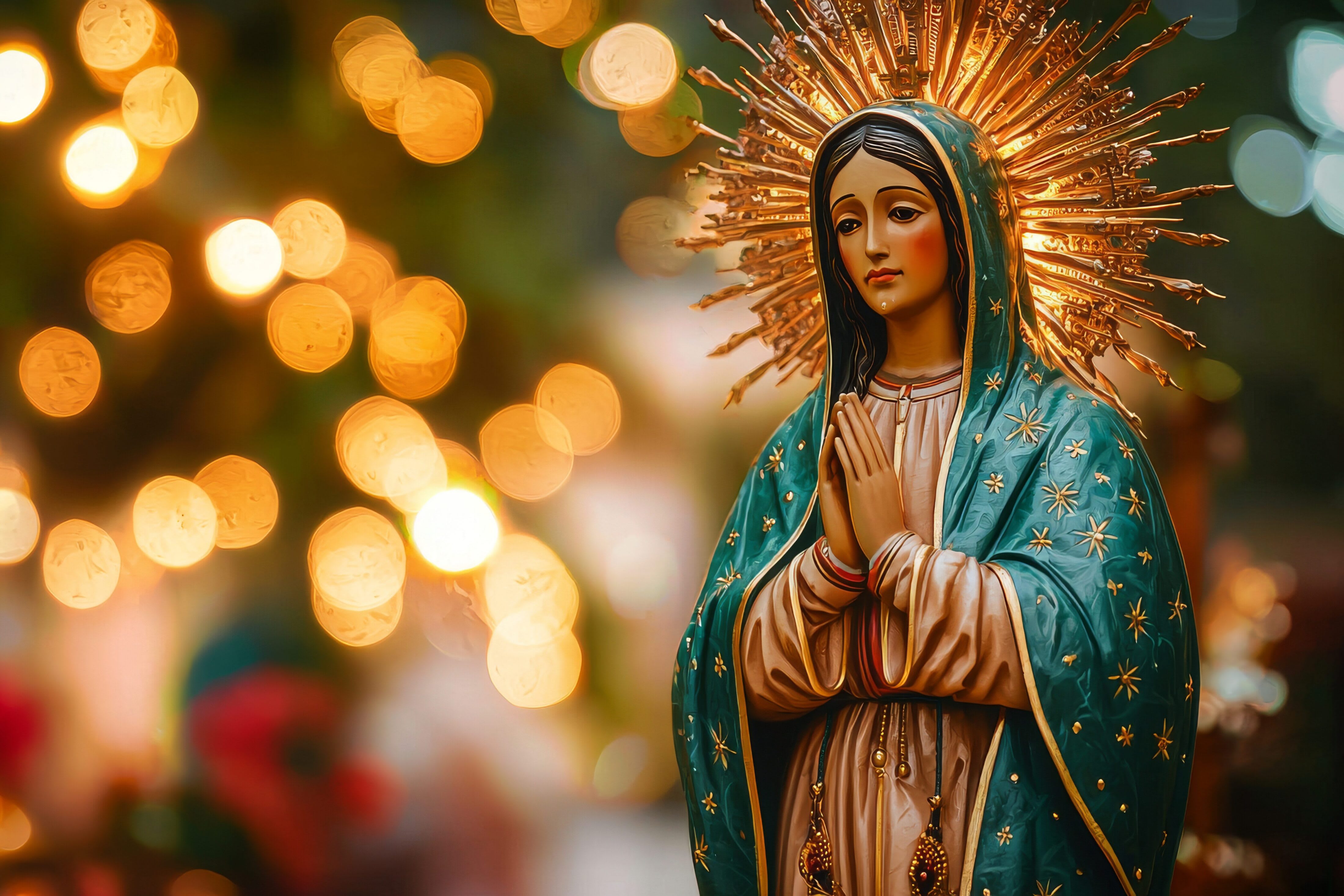
The Altar and His Statue
by Emma Ramoy
A flying sparrow sees Mexico City as a finely textured cloak, woven from red and white threads, interrupted by diagonal seams. Zooming closer, these threads become rooftops, the seams Parisian avenues. Stitched into this fabric are small altars guarding busy intersections, protecting taxi stands, discouraging crime in quiet neighborhoods. Each holds a statuette of Our Lady of Guadalupe, patron saint of Mexico.
The sparrow perches on the roof of the altar at Metro Chapultepec.
This altar is about four feet tall, a simple concrete box with an arched niche on the front, painted a pale blue except the white cross mounted on its hipped roof. When a woman placed a ceramic statuette of Guadalupe in that niche, the morning’s dew still clung to the concrete. As the woman walked away, Guadalupe’s hard insides turned soft. Light spilled out from her cloak and reflected on the curves of the walls. The soft yellow glow dried the morning’s dew.
The altar instantly knew that Guadalupe was his everything, his purpose for being. Her proportions perfectly complemented his void. It was like Guadalupe was made for him. He could tell by the way others looked at them together. Men in suits stopped to admire the altar and his statue. Taxi drivers left charms and trinkets at the statue’s feet. Grandmothers lay fresh roses at his cement base.

Headlights swept by on both sides, blurring into endless strands of light. The sky brightened and darkened and brightened again, the sun and moon playing an endless game of chase.
The altar complimented Guadalupe’s cloak and crown and she laughed and beamed up at him from his niche. Her laughter sounded like church bells. He loved listening to her talk. Especially when she spoke of the past, of that time before it was called Mexico City. She spoke with pride, and her words transported him to another place. A passing motorcycle engine became the buzz of a hummingbird’s wings, the bus horn the low growl of a jaguar.
“Por favor, tell me again,” the shrine whispered. “Una vez más”.
As Guadalupe spoke, the traffic noise disappeared and the lights of the city transformed into constellations. He could smell meat cooking on a campfire, and he heard the shores of Lake Texcoco lapping gently onto its volcanic soil.
Once, but only once, she told the altar how she was one of many identical statues that had lined the shelves in the mercado, cheeks the same pink, cloaks the same blue. She watched her ceramic sisters chosen, bought, and carried off, one by one. He thought this made her sound ordinary, when she was clearly not. When her day came, she stared bravely ahead as a woman carried her out of the fluorescent lighting, through a jostling metro ride, and across three lanes of noisy traffic. She told him that she was happy to be here with him. He said it was destiny and she smiled. Her shiny lips sparkled in the moonlight.
Guadalupe had this way of listening, as if his words were seeping into her body and infusing her with wisdom. He shared his earliest memories with her, of when the world was dark and he was shapeless. He shared how his body formed within the curves of his plywood formwork. How heat grew within him as the smell of wood mixed with his slurry. How streaks of light invaded his world as the wood was pried from his body. He remembered the harsh sun slicing through a long crack that spread down his side. He had feared that he would always be alone.
The altar stopped speaking and for a moment he was far away. Guadalupe traced the length of his fracture with her eyes. It had been patched, plastered, and painted, but she could still sense it. When she finally spoke, the roses unfurled and their smell floated away in a hazy, pink mist. A golden glow spilled from the statue’s crown and blanketed the city. The altar released the heat trapped within his mass like a memory of the sun.
She left on a sunny afternoon in February. A man removed the poinsettias and fairy lights that adorned the arch she had stood beneath. The altar watched Guadalupe, bathed in golden winter light, as she disappeared down the metro station stairs tucked under the man’s arm. He was sure she would look back, but she did not. He thought she would return, her cheeks and eyes freshly painted.
The roses turned gray and shriveled. The sparrows left white sticky spots in their wake and nobody cleaned them off. Teenagers ripped the altar door from its hinges and the glass shattered on the ground. Leaves fell from the tree above and littered the hollow space inside where she had stood. Summer thunderstorms echoed within his unprotected cavity and rain warped the paint. When the altar dried, thick slabs of plaster fell off, exposing his raw concrete bones. None of this mattered to the altar. He thought only of Guadalupe.

by Emma Ramoy