B’nai Israel Sanctuary Renovation
Shechinah, often explained as a bridge between the transcendent and the everyday, is a post-biblical Hebrew word derived from the words shachan which means “to dwell,” and mishkan which means “dwelling.” It is our hope that the ways in which light enters this sanctuary and inhabits its fabric surfaces evokes this presence.


Shechinah is also thought of as a physical manifestation of God, particularly in the pillar of cloud, described in Exodus, that led the Hebrews out of Egypt and through the desert. This cloud has also been described as a physical presence that hovered over the Ark of the Covenant in the Desert Tabernacle and Holy Temples in Jerusalem. The fabric of the Ark bridges into the congregation over the bimah as the “Shechinah cloud” and the marriage chuppah which represents “home.”
The fabric and glass panels of the Ark, the detailing of the high windows to adjacent Land Park and the translucent cloud over the bimah visually and spatially overlap such that the edges of each of the elements are elusive. In this way, a cloud in the sky might visually blend with the fabric of the Ark. The play of daylight on and artificial light within the Ark is meant to add to its temporal and ethereal quality and fill it with and cast upon it an ever-changing light.


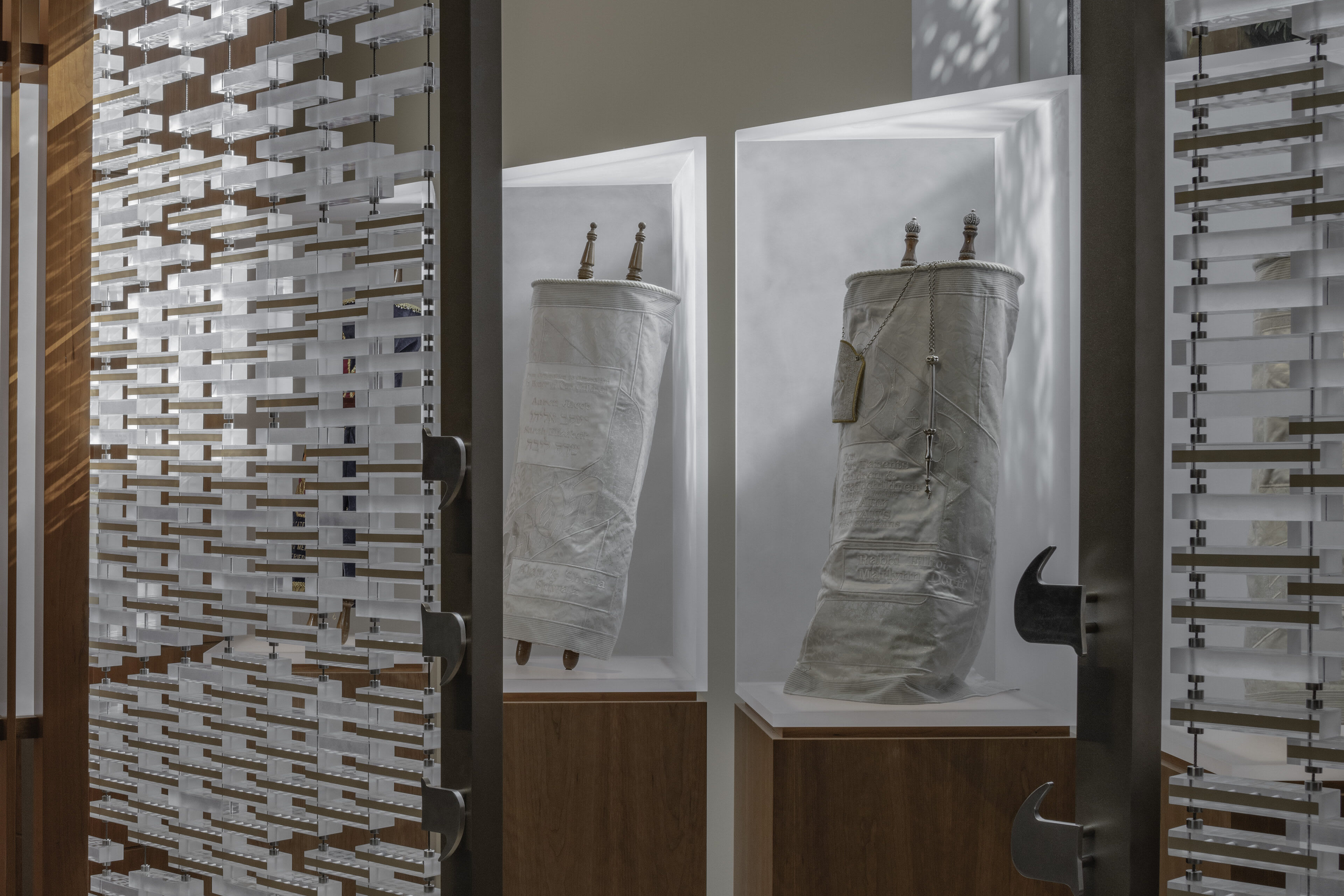
The Ark is suspended above a depression in the bema floor that is filled with sand from Israel. The Torah scrolls inside the Ark are seen in silhouette and appear to hover above the sand.


The Ark doors represent a “mixing of the waters” of the Sacramento River Delta and the Mediterranean Sea. A mapping abstraction connects the Sacramento River to the greater Delta, San Francisco Bay, Pacific Ocean, and across the globe to the Mediterranean Sea and Israel through a collage of varying scales and etched layers.
On the left-hand door, horizontal hatches represent rows of crops, the lifeblood of the Sacramento Delta. On the right door, the Hebrew names of the weekly parshiot are scribed from top to bottom. The cycle of parshiot is represented as an analog to the cycles of farming. This panel also shows the “footprint” of the sanctuary and social hall as they relate to the river flowing behind the synagogue.

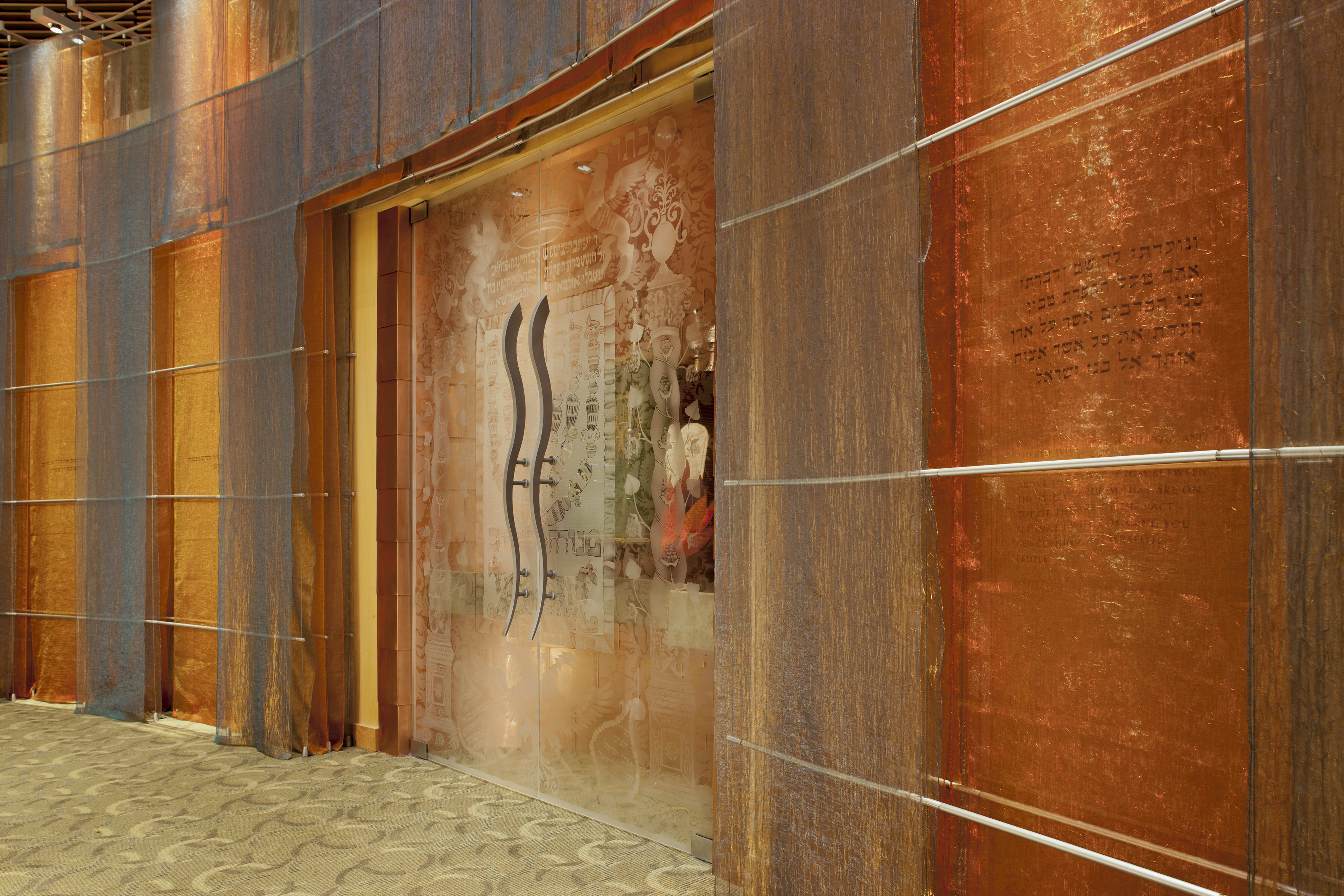
The stone entryway to the south lobby is wider on the right than on the left. This dimension evokes an emphasis made on the “mezuzah side” of a doorway. The glass canopy includes the text of the mezuzah. The stone “carpet” outside the entry resembles the pattern of a tallit. This tallit pattern is also reflected in the silhouettes that project against the diffused glass of the lobby windows at night and in the windows in the sanctuary.

The lobby and its light and lighting are meant to create a transition space that prepares one for the spirituality of the sanctuary. The hammered copper panels in the lobby and on the sanctuary façade abstract a Talmud page. To the right of the sanctuary door, a mezuzah glows.

The copper and glass composition on the façade is a graphic representation of a Talmud page, and it includes an excerpt from “Bameh Madlikin/Shabbat” (Chapter Two) describing the story of a student who asks Hillel to teach him the entire Torah while standing on one foot. Hillel replies, “That which is hateful to you, do not do to your neighbor (love thy neighbor as thyself). This, in a few words, is the entire Torah.”

This text is etched in glass, and the quote is highlighted in copper leaf. The words “B’nai Israel” are also coincidentally found in this text and are highlighted as well. The surrounding copper panels abstract the Rashi, Tosafot, Glosses and other commentaries attributed to centuries of Jewish thought on every Talmud page.